BlogHeyPCB Memo
We Built Pocket, but Better.
HeyPCB Memo rethinks Pocket as one 52 × 28 mm board in an editable aluminum shell, with open-source PCB, CAD, and firmware to build on.
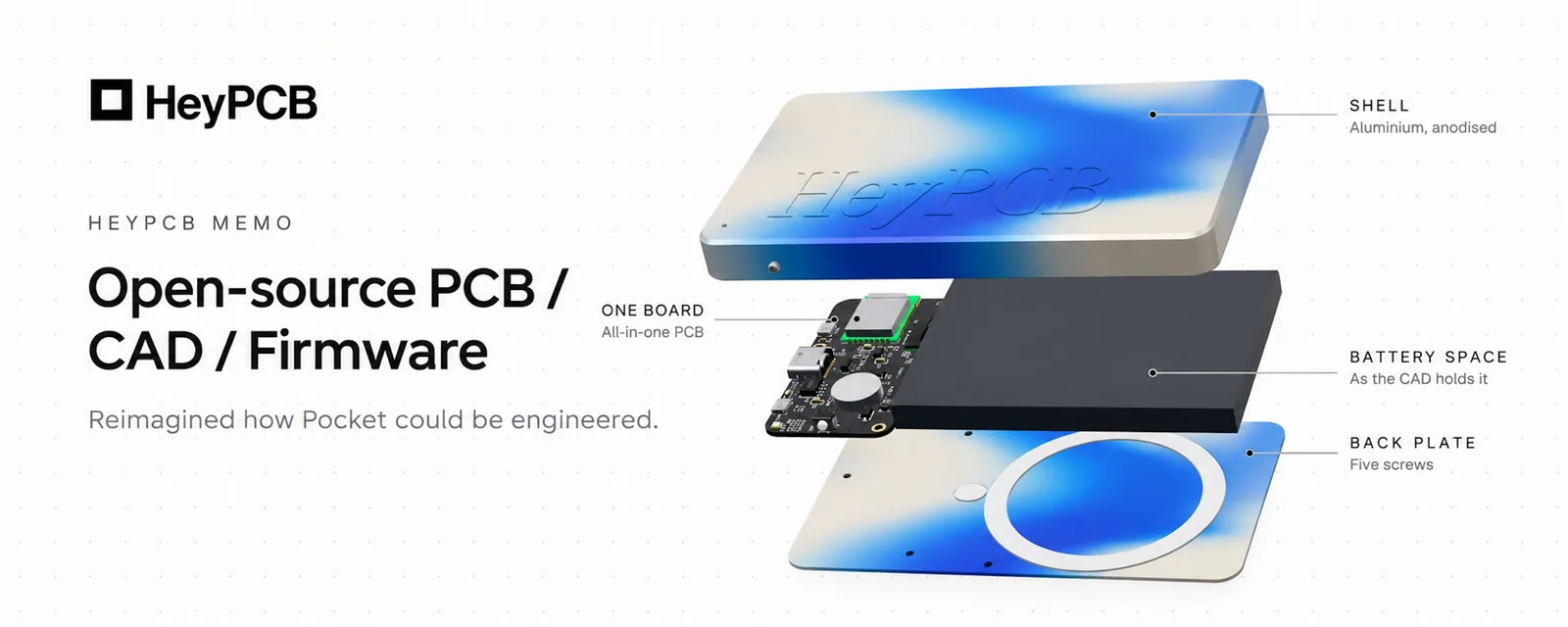
We wanted to rethink how a device like Pocket could be designed, from its electronics and enclosure to the firmware running inside. The result is HeyPCB Memo. Designed end to end with HeyPCB, with a more integrated architecture and an open-source design you can take further. !Dark exploded Memo labeled with a 6061 anodised shell, a one-sided board, battery space, and a five-screw back plate. The circuit board and enclosure were designed together. A machined aluminum shell surrounds the electronics and battery, with five screws securing the back plate. For a different way to build it, there’s a 3D-printable enclosure too. !Populated black PCB with USB-C above a bare board silkscreened HeyPCB Recorder V2 2024-10. Pocket separates its main electronics and USB-C port across two boards. Memo brings them together on a single 52 × 28 mm, four-layer PCB, with every component mounted on one side. That eliminates the secondary board and its ribbon cable, reducing the number of parts and connections involved in assembly. !A hand holds a red case with a Liter Energy 504050 battery wired to a populated USB-C board. !Opened gray device marked Pocket-V1.3, with a battery, a yellow flex cable, and a small board at the bottom. We didn’t make thinness the only design priority. Memo keeps the electronics at one end, leaving a dedicated space for the battery without an inter-board cable crossing it. And because the enclosure is editable, its dimensions aren’t a permanent constraint. A different battery can become a new design revision, rather than an entirely new product. !HeyPCB page for Memo by inky, with a board render, 52 × 28 mm size, 54 parts, case files, and 88 KB firmware. The PCB, enclosure and firmware are available to inspect, modify and build upon. Change the circuitry. Reshape the enclosure. Rewrite what happens when you press the button. We believe open source is how progress compounds. One person’s work becomes another person’s starting point. Publishing a design shouldn’t be where its development ends. !HeyPCB explore page showing board grids for keyboards, IoT, computing, robotics, dev boards, and other categories. Memo is one example. Circuit World brings together more than 15,000 open-source PCB designs to learn from and build on. With HeyPCB, that starting point can become a different circuit, a new board and an enclosure designed around it. The same platform used to develop Memo is available to help you build what comes next. heypcb.ai/memo